Understanding how earnings behave—and who they ultimately benefit—provides important context for evaluating the industry’s role in the broader economy. It also highlights why strong, sustained investment has positioned the United States more favorably than many regions that rely more heavily on energy imports than domestic supply.
Earnings in the oil and natural gas industry are primarily determined by global commodity prices.
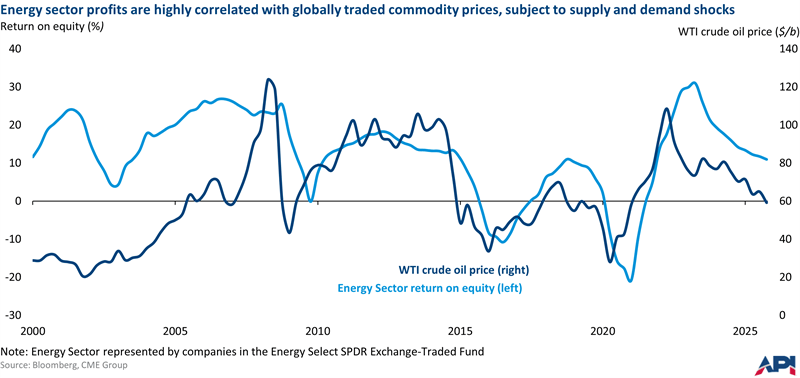
Oil and natural gas prices are set by supply and demand in global markets. When supply has been disrupted or demand is strong, prices have risen—and earnings have typically followed. When markets have weakened, earnings have declined. The same market that leads to higher earnings also generally indicates a need for additional supply—helping drive future investment decisions.
Energy company earnings help fund reinvestment, operations, and future energy supply.
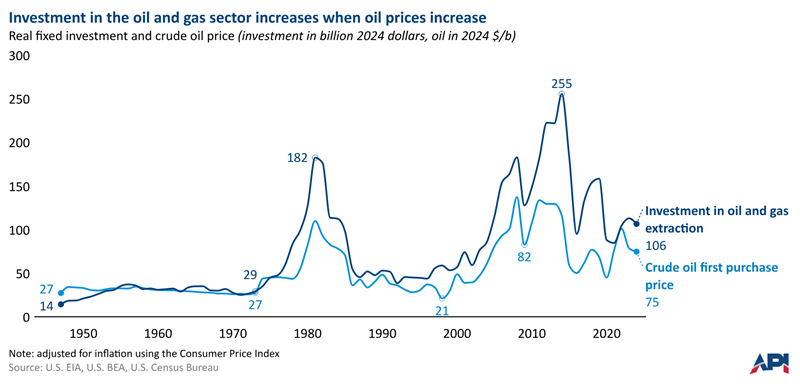
A significant portion of earnings is reinvested into developing new oil and natural gas supplies, maintaining infrastructure, and improving efficiency.
These investments often take years to plan and complete and depend on confidence that market conditions will remain supportive.
Companies also use earnings to strengthen balance sheets after downturns and provide returns to investors who help finance long-term projects.
Energy production cannot increase quickly in response to short-term price changes.
Even in highly responsive regions, increasing supply requires time, capital, equipment, and workforce capacity. Companies also need confidence that market conditions can support making new investments.
There is no “flip the switch”—production growth depends on sustained market conditions. This is why consistent, long-term investment is essential to meeting future demand.
Energy prices—and company earnings—are largely influenced by global market conditions.
Oil and natural gas are traded in highly competitive global markets where prices respond to supply and demand. When supply has been disrupted or demand has increased, prices have risen across the market—not just for a single company.
Repeated investigations by the Federal Trade Commission have found that changes in gasoline prices are driven by market conditions rather than price manipulation.
Policies that target earnings during high-price periods can discourage the investment needed to maintain supply.
The energy industry relies on sustained, long-term investment to develop new resources and maintain existing infrastructure. Reducing returns during periods of higher prices can limit the capital available for future production, which can negatively impact supply over time.
The energy sector has lower average profit margins and greater variability than many other industries.
Over time, energy companies have operated with thinner average margins than sectors like technology or financials, while also experiencing wider swings in performance.
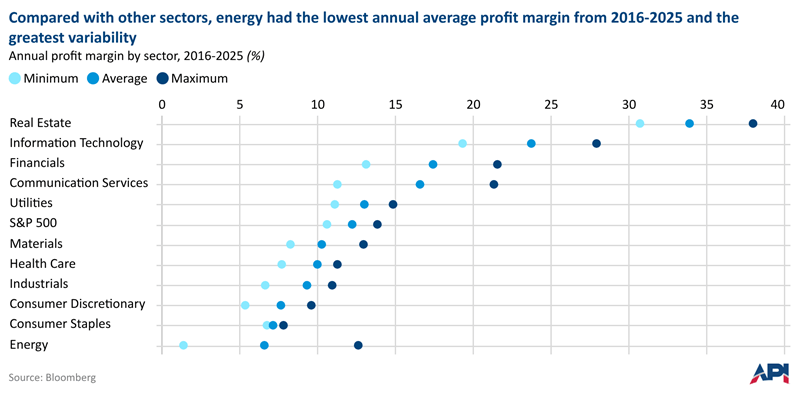
Energy earnings fluctuate more than other industries because they are tied to global commodity cycles.
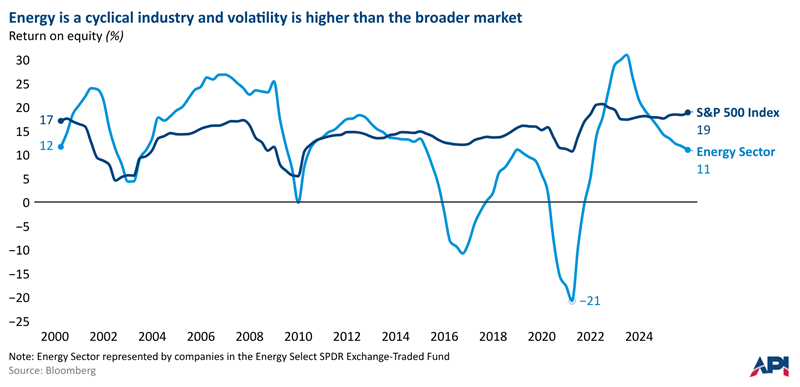
Returns tend to rise and fall more sharply than the broader market, reflecting shifts in supply, demand, and global events. Over time, this has included both periods of strong performance and periods where returns lagged the broader market.
Taken together, this means the energy sector tends to experience higher highs and lower lows than many other industries.
Millions of Americans have a direct stake in the industry’s performance.
A large share of oil and natural gas company stock is held through retirement accounts such as 401(k)s and public and private pension funds—benefiting workers including teachers, firefighters, and other public employees.
Financial institutions and asset managers also hold significant stakes on behalf of investors, including pension funds, endowments, insurance companies, and investment funds.
This means industry performance affects not just companies but may also affect the retirement savings and financial security of millions of Americans.
Click here to download as a PDF.
Last updated: April 27, 2026
Putting Earnings in the Oil and Natural Gas Industry into Perspective
File Size: .9 MB