Welcome to the inaugural edition of the American Energy Snapshot, a newsletter from the American Petroleum Institute where we’ll provide context, data and perspective on current events, policy and energy.
As explained by the U.S. Energy Information Administration, the retail price of gasoline typically reflects four main components: crude oil (about 51%), refining (around 20%), distribution and marketing (about 11%) and federal and state taxes (roughly 18%).
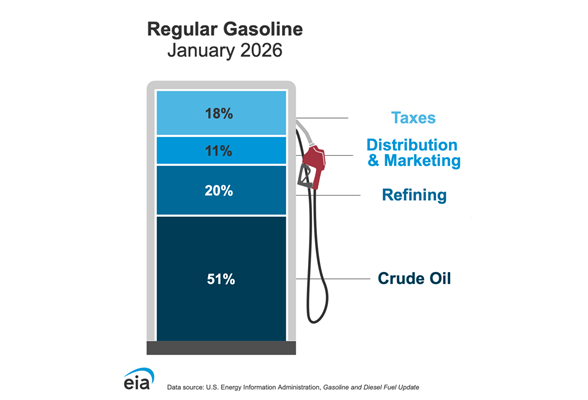
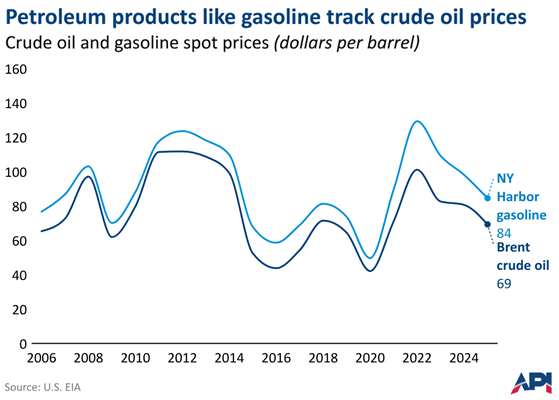
Crude oil is the single largest component of the price consumers pay at the pump. Refineries buy crude oil and process it into gasoline and other products like diesel and jet fuel. The price of that oil is set on global markets that respond to worldwide supply and demand.
That’s why gasoline prices have generally tracked oil prices — when crude rises or falls, gasoline has tended to follow.
Turning crude oil into gasoline requires complex operations, infrastructure and inputs. Refineries incur costs for labor, additional inputs, maintenance, fuel and electricity.
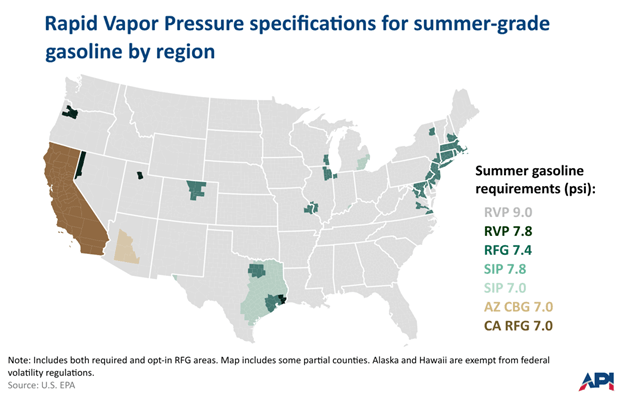
Refining costs also vary by region and time of year. In the summer, refineries produce gasoline that can better handle warm ambient temperatures. And different parts of the country use different gasoline formulations, which vary in cost.
Once a refinery produces gasoline, it’s transported by pipeline, ship, truck or train to fuel terminals and eventually to retail gas stations. Pipelines are usually the most cost-effective way to transport fuel from a refinery, but some regions lack the infrastructure.
Marketing costs reflect the expenses associated with operating the gasoline station such as fuel and labor costs, real estate taxes, distances from the terminal to the station, and competition with other stations.
Federal, state and local taxes also contribute to gasoline prices.
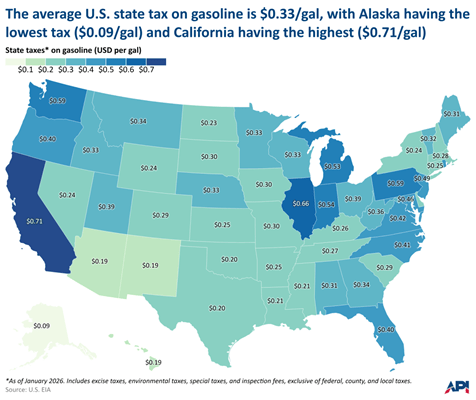
On average, state taxes add about 33 cents per gallon, bringing the combined federal and state average to roughly 51 cents per gallon. Some states and municipalities also apply additional sales taxes or local fuel taxes.
Both crude oil and gasoline are commodities traded in global markets, where prices are set by supply and demand. Crude oil — the single largest component of what you pay at the pump — is priced globally.
Wholesale gasoline trades alongside it under a benchmark called RBOB (Reformulated Blendstock for Oxygenate Blending). When global supply tightens anywhere, those benchmarks can move — and U.S. pump prices can follow.
That's why a disruption in the Strait of Hormuz shows up at American gas pumps. It remains a critical global energy chokepoint, with roughly 20 million barrels of oil per day — about 20% of global petroleum liquids consumption — normally passing through it prior to today’s conflict. When the Strait closed, the global supply of both crude oil and fuels, including gasoline, tightened. And the prices of crude oil and RBOB have followed.
Even though the U.S. only imports a small share of its oil from the Middle East — around 8% — and is the world’s largest producer, we’re still part of a connected global system. Prices are set globally, so disruptions abroad can still show up at American gas pumps.
If you’re interested in learning more, visit our American Energy Snapshot dashboard to view key indicators on U.S. energy production, inventories and trade.