Summer travel season is approaching, and with it, increased fuel demand. But this year, disruption in the Middle East is rippling across global fuel markets — and in many regions, jet fuel prices have risen faster than gasoline or diesel.
In this edition of American Energy Snapshot, we explain why — even amid strong U.S. production — jet fuel markets are under particular pressure.
Countries in the Persian Gulf play two important roles in global jet fuel supply: They export a significant share of the world’s jet fuel and supply crude oil to refineries — particularly in Asia — that produce and export jet fuel globally.
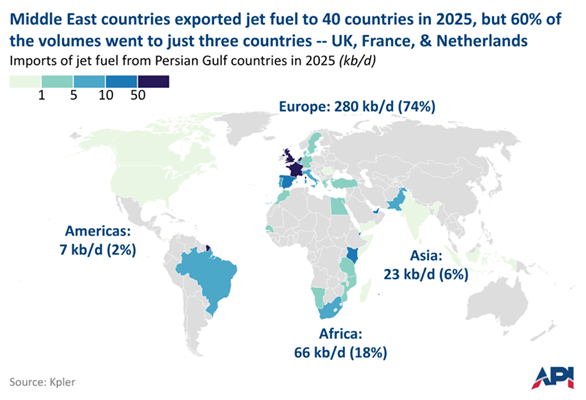
Before the conflict, refineries in the Persian Gulf produced and exported roughly 20% of the world's seaborne jet fuel — about twice the share of seaborne diesel. When the Strait of Hormuz was disrupted, those exports all but stopped. Most of those jet fuel exports were destined for Europe, which is why supply there has been more acutely impacted.
About 40% to 60% of the crude oil that refineries in China, South Korea, and India imported and processed into jet fuel and then exported to other markets transited the Strait of Hormuz. Without crude oil from the Persian Gulf, those Asian refineries have cut runs and reduced their own exports, including jet fuel.
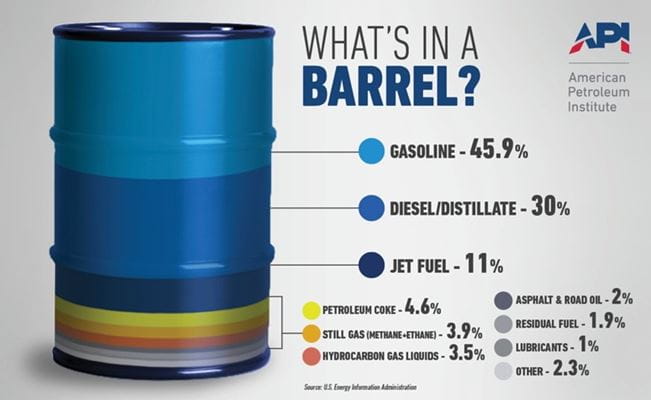
An average barrel of crude oil processed in a U.S. refinery becomes 19.3 gallons of gasoline, 12.6 gallons of diesel (or distillate), and only about 4.6 gallons of jet, according to 2025 data from the U.S. Energy Information Administration.
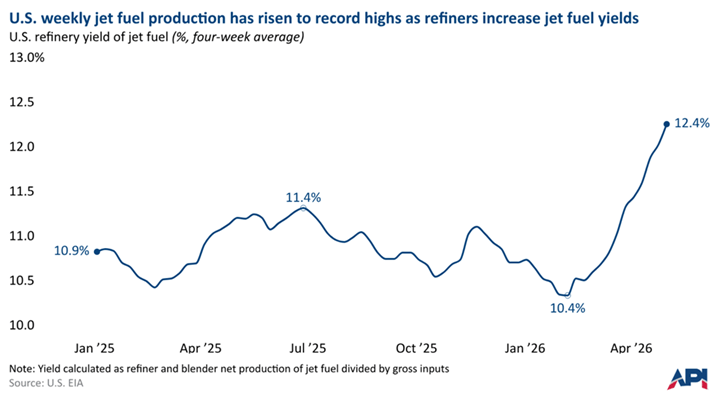
Refineries process crude oil into a range of products — the big three are gasoline, which most of us put into our cars, motorcycles and small boats; diesel, which powers trucking, trains, ships and more; and jet fuel, which fuels jet aircraft and helicopters. But only about 11% of each barrel becomes jet fuel, and it’s generally difficult to increase that share. In the U.S., refineries have only been able to increase jet fuel production by roughly 2-4%.
Specific parts of a refinery are designed to produce certain fuels and have limited flexibility to change. For example, many refineries have a unit called a fluid catalytic cracker — or FCC — that mostly makes gasoline. Refinery operators can adjust the FCC to produce some jet fuel, but it has limits, because that’s not what the unit was built to do.
The United States is the world's largest producer of crude oil, operates one of the largest refining systems and imports very little crude or jet fuel directly from the Middle East — leaving it less exposed than Europe or Asia. But jet fuel, like crude oil, is a global commodity, and even in the U.S., its price has been affected by global markets.
The West Coast shows how quickly disruptions abroad reach home. California and other Pacific states rely on imports for about 20% of their jet fuel, mostly from South Korea, whose refineries depend on Middle Eastern crude. Strong domestic production improves resilience — but in a connected global market, it can't fully shield American consumers from a crisis halfway around the world.
To follow the latest data on U.S. production, inventories and energy markets, visit API's American Energy Snapshot dashboard.