As America approaches its 250th anniversary, instability in the Middle East is a reminder of one of our country's greatest modern achievements: we changed our energy destiny. A generation ago, global disruptions exposed America's dependence on foreign energy. Today, the United States is the world's leading producer of oil and natural gas.
America didn't become an energy superpower by accident. It was built through decades of innovation, investment and policies that expanded access to our abundant natural resources. Now, the next federal offshore leasing program will help determine whether that advantage endures well into the 2030s and beyond.
API's American Energy Security Framework identifies strengthening offshore leasing as a key priority for preserving America's long-term energy advantage. This week's American Energy Snapshot explains why.
Today's offshore industry operates under one of the world's most robust safety and operational frameworks. More than 275 API standards and recommended practices help guide offshore design, construction and operations, supporting continuous improvements in safety, reliability and environmental performance.
Shale and offshore production play different — but complementary — roles.
Shale production provides speed and flexibility. Offshore production requires years of planning and investment, but delivers large, durable supplies of energy for decades. Together, they create a more resilient energy system.
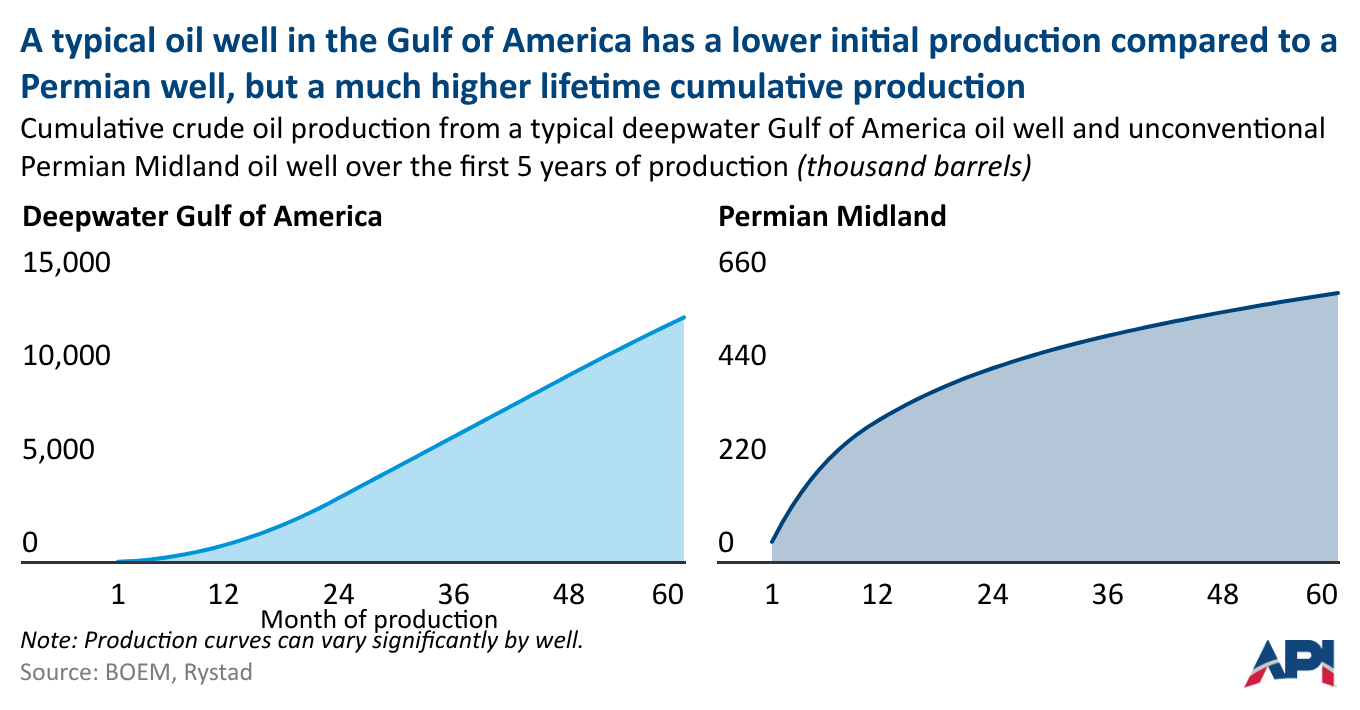
According to Rystad Energy, a single offshore well can recover more than 10 million barrels of oil equivalent over its lifetime, while a typical Permian shale well produces less than one million barrels. Data from the U.S. Energy Information Administration shows that in 2025 just 18 deepwater facilities accounted for nearly 10% of U.S. crude oil production — more than the combined output of Oklahoma, Colorado and Wyoming.
America's energy advantage comes from a diverse energy system designed to deliver reliable energy safely and over the long term.
Offshore production creates value far beyond the barrels it produces.
It supports around 250,000 high-skilled American jobs, generates billions of dollars in public revenue, helps fund conservation through the Land and Water Conservation Fund, and supports American ports, manufacturers and a broad U.S. supply chain.
Unlike most onshore production, offshore development depends almost entirely on federal leasing decisions.
Because projects require years of planning, billions of dollars of investment and often produce for decades, today's leasing decisions will help determine how much American energy is available well beyond the 2030s.
The upcoming five-year offshore leasing program is one of the country's most consequential long-term energy policy decisions. API has advocated for opening a relatively small area in the South-Central Gulf that could produce more than 470,000 additional barrels of oil per day by 2040, while leveraging existing infrastructure. Alaska and the Pacific also represent important opportunities to strengthen regional supply security and America's long-term resilience.
Offshore oil and natural gas production is one of America's greatest strategic assets. It provides reliable energy for decades, supports high-paying American jobs, generates billions of dollars in public revenue and strengthens our ability to respond to future disruptions.
America didn't become an energy superpower by accident — and it won't remain one by accident. Preserving that advantage requires long-term policy choices today so America has the energy it needs for the next 250 years.
We publish a new edition of American Energy Snapshot every week through our LinkedIn newsletter. To see previous editions and to receive new ones, please subscribe.